
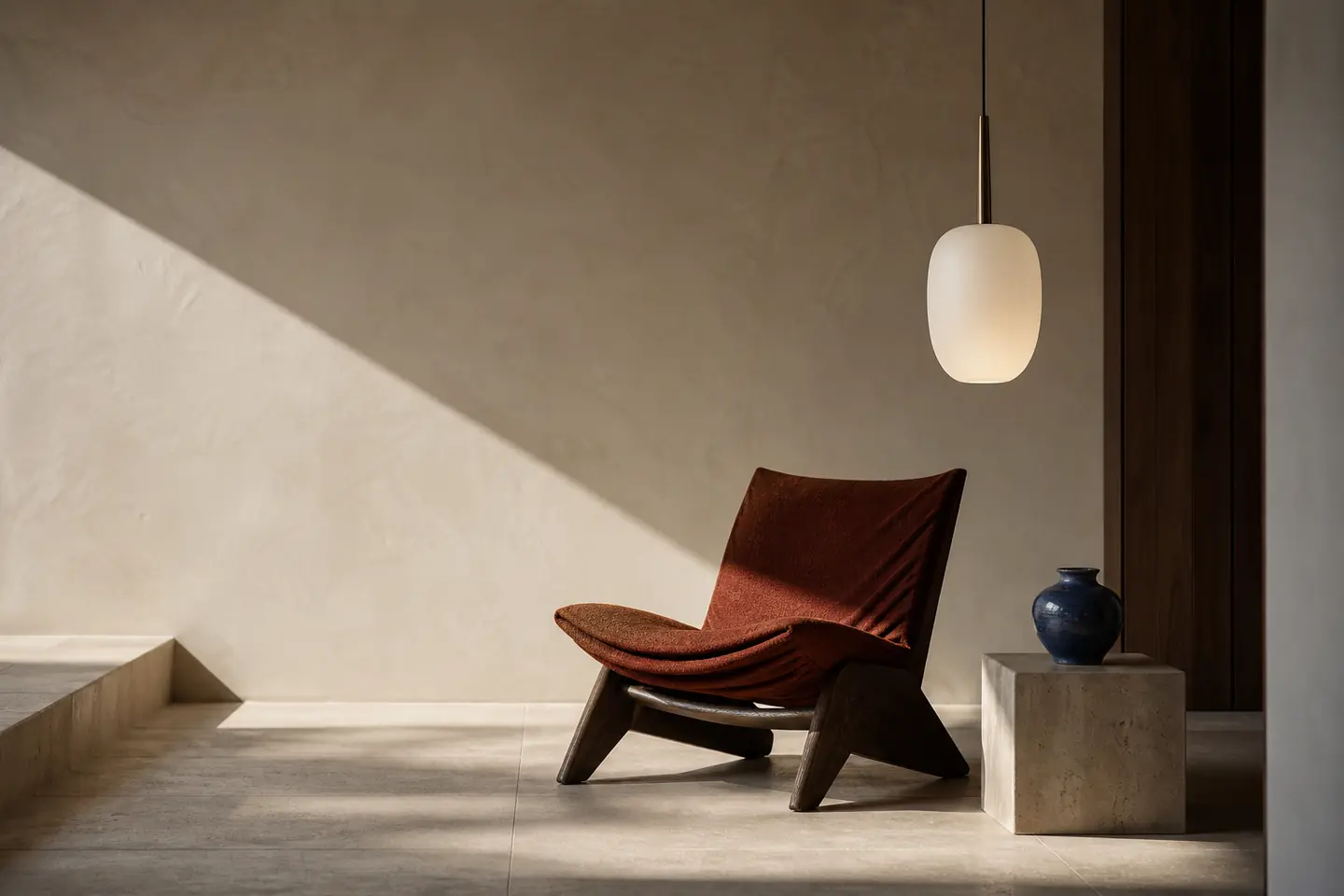
An illustrative study can communicate a visual idea with precision. It cannot prove that an object exists, performs safely, can be purchased or belongs to a completed project.
Begin with the silhouette
Notice what remains legible before you consider surface detail: the chair's low posture, the pendant's vertical line or the vessel's offset rim. A strong catalogue image should make the primary form easy to compare at card and detail-page scales.
Read light as part of the composition
Directional light can reveal a fold, separate an edge and establish mood. It can also make a surface look more refined than a production sample might be. Treat lighting as art direction, not evidence of colour, finish or material performance.
Ask what the image cannot answer
A useful product record still needs verified dimensions, composition, care, compliance where relevant, price, availability and an accountable destination. Those facts must come from an authoritative source, never from visual inference.
Keep the next step specific
When moving from interest to enquiry, cite the visible study reference, intended setting and the decisions still open. That turns an attractive image into a clearer conversation without pretending the image is proof.